Pop Art and Andy Warhol Lesson for Kids and Teens You Tube
Andy Warhol/Digital Self-Portraits
Grade Level: seven–8
Students will be introduced to the life and fine art of Andy Warhol as a fashion of considering photography as a self-portrait medium. Subsequently viewing and discussing other artists' photographic self-portraits, students volition create their ain digitally manipulated photographic cocky-portrait and then write a poem to describe the indicate of view taken in their digital work of art.

Andy Warhol
American, 1928–1987
Self-Portrait, 1986
synthetic polymer paint and silkscreen ink on canvas, 203.2 x 203.2 cm (lxxx ten 80 in.)
National Gallery of Art, Gift of the Collectors Committee
Curriculum connections
- Language Arts
Materials
- Smart Board or reckoner with ability to project images from slideshow
- Student photograph
- Computers equipped with digital-imaging software such equally Adobe Photoshop (or Adobe Photoshop Elements), Corel PaintShop, or other package capable of applying color and/or special effects
- Scanner
- Color printer
- Copies of the "Write an 'I Am' Poem" worksheet
Warm-Up Questions
How do yous think this self-portrait was made? Why exercise you call back he included four images of himself rather than 1?
Background
Andy Warhol became fabulously famous for his 1960s pop art. He produced large, bold images of the popular, the famous, and the stuff of our consumer society. His multi-image portraits of famous people—Marilyn Monroe, Elvis Presley, Jacqueline Kennedy—and of common products—Campbell's soup cans, Brillo pad boxes, Coca Cola bottles—are among the most powerful icons of twentieth-century American art.
Andy Warhol was built-in Andrew Warhola, the son of Czechoslovakian immigrants, in 1928. He grew up poor (during the Depression) outside Pittsburgh, Pennsylvania, with his parents and two brothers. Equally a child, Warhol (he afterwards dropped the final "a") recalled having a few friends simply also feeling "left out." He suffered briefly from a nervous disorder that caused muscle spasms and kept him isolated. He liked spending fourth dimension on his own, coloring, taking snapshots with a small-scale camera, and even making films with a picture show camera given to him by his mother.
Afterward graduating in fine art from Carnegie Institute of Technology in 1949, he moved to New York Metropolis, where he would accept quick success as a commercial artist. He designed window displays, illustrated magazine articles, and drew record album jackets. In the 1960s, Warhol decided to abandon commercial fine art to focus on making serious visual fine art. While he hand-painted his first works, he soon developed a silk-screen process that allowed his staff of assistants to mass-produce the startling images of consumer products and bright movie star portraits. These works took the art earth and the public by storm. In this self-portrait, he used iv photographic images of himself (with his trademark "shocked" pilus) and silk-screened them, off-kilter, onto a half-dozen-foot square canvas. The issue is iv big heads, fix in supercharged pink and yellow against a glossy, dense black background. The issue is intense and unsettling.
Guided Practise
Warhol said he was "deeply superficial" (is that possible?) and that there was absolutely zero backside his piece of work. Do you lot think his statements fit with his self-portrait? Is it superficial?
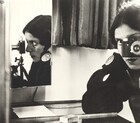
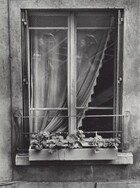
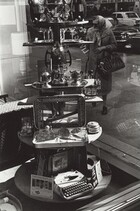
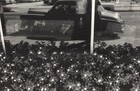
Warhol wasn't the merely creative person nor the first to brand unusual and thought-provoking self-portraits with photographic images. In preparation for the activity, view the slideshow below to see how two other artists—Ilse Bing and Lee Friedlander—manipulated photographs to say something nigh themselves. Accept students identify how the following choices fabricated by each artist limited their unique self-image:
- Setting
- Poses
- Costumes and/or props
- Cogitating surfaces
- Cropping
- Absence of the physical self
- Presence of other people
Slideshow: Bing & Friedlander: Photographic Self-Portraits
Activity
In this action, students volition outset with a photo of themselves and and then use imaging software to apply special furnishings and alterations:
- Once students have their photo downloaded to the reckoner, they can use digital-imaging software such as Adobe Photoshop (or Adobe Photoshop Elements), or other packet capable of applying color and/or special furnishings.
- Start with the crop tool to eliminate any areas of the photo they don't want to keep. They can also play with the size and rotation of their image.
- Side by side, have them experiment with paint tools, filters, color levels, and any other editing tools available. They could even add text and original graphics to their picture, or copy and paste multiple images of themselves.
- As students manipulate their digital image, accept them consider what they want to communicate most themselves. What will the viewer who examines their cocky-portrait larn about them?
- Students should create 2 or three unlike variations of their flick.
Here's an example of a educatee'south work of art:

Benjamin Kass,
Photograph by Al Garnache
Using a digital camera and special graphics-editing effects, Ben created his self-portrait. He gave some thought to the pose he wanted when he was photographed.
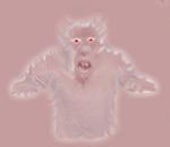
Wolf past Day
by Benjamin Kass
Next, Ben manipulated his digital portrait with an image-editing plan (such every bit Adobe Photoshop). He experimented with special-effects filters until he arrived at the color scheme he wanted. Using a smudge tool, Ben created a fierce advent. To elongate the jaw, he used an oval select tool to isolate and copy the surface area effectually the mouth. He then pasted it to a new layer, then information technology could be worked on without affecting the residuum of the picture. He stretched and smudged the mouth until the desired effect was accomplished. Finally, he used the brush-tool to pigment the eyes.
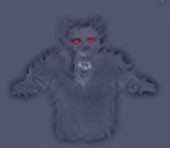
Wolf by Dark
by Benjamin Kass
Ben connected to experiment with filters to change the color scheme. The finished product looks like a wolf-man from a 1950s horror film!
Extension
Subsequently printing out their finished self-portraits, take students compose a verse form based on their digital self-portrait using the "Write an 'I Am' Verse form" worksheet. Remind students that the thoughts expressed in their poems should be reflected in the image they created in their digital cocky-portraits.
National Core Arts Standards
VA:Cr1.2.sevenDevelop criteria to guide making a piece of work of art or blueprint to meet an identified goal.
VA:Cr2.1.7Demonstrate persistence in developing skills with various materials, methods, and approaches in creating works of art or pattern.
VA:Cr2.3.7 Apply visual organizational strategies to blueprint and produce a piece of work of art, design, or media that clearly communicates data or ideas.
VA:Cr3.1.vii Reflect on and explicate important information about personal artwork in an artist statement or another format.
VA:Re7.2.8 Compare and contrast contexts and media in which viewers encounter images that influence ideas, emotions, and actions.
VA:Re8.1.viii Interpret fine art by analyzing how the interaction of subject matter, characteristics of course and structure, apply of media, fine art-making approaches, and relevant contextual information contributes to agreement letters or ideas and mood conveyed.
Source: https://www.nga.gov/learn/teachers/lessons-activities/self-portraits/warhol.html
0 Response to "Pop Art and Andy Warhol Lesson for Kids and Teens You Tube"
Post a Comment